
Research
In quantum materials, electrons transcend their individual identities and produce spectacular collective quantum phenomena at macroscopic scales. Interacting electrons self-organize into ordered phases, develop macroscopic coherence in superconductors, quantized responses in topological materials, long-range entanglement in quantum spin liquids, and fractionalize into emergent quasiparticles in low dimensions.
Beyond being a deeply fascinating area of study, understanding these phenomena will allow us to harness the quantum nature of matter in transformative new technologies, from communication and sensing to new computing paradigms.
In our research, we use light, spanning THz to x-rays, as a means to to probe, control, and engineer quantum materials at their fundamental length and timescales. Our efforts are organized around two broad themes, described below.
Deconstructing quantum materials
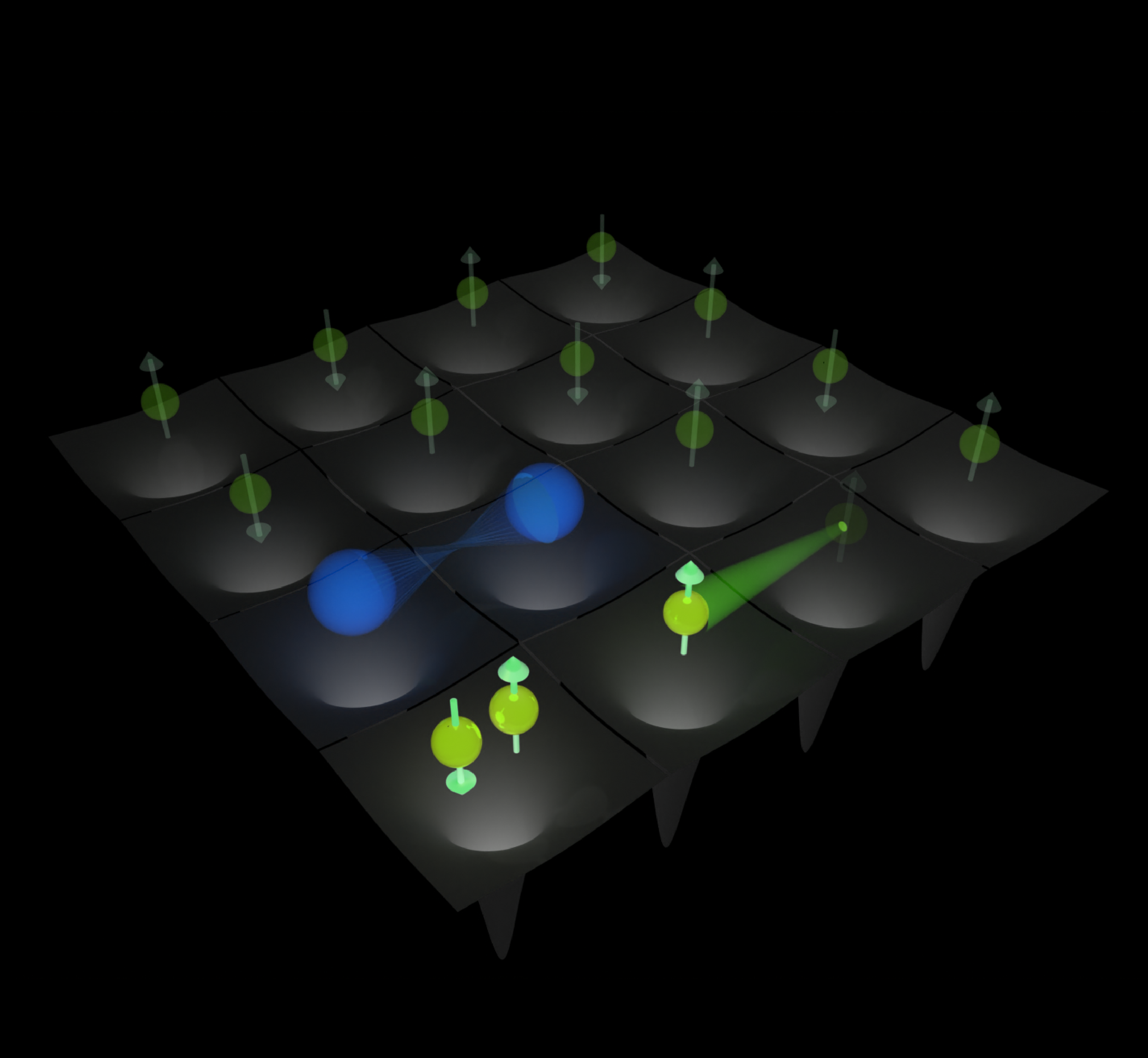
Emergent phenomena in quantum materials have their roots in well defined microscopic interactions. In our work, we get to the heart of quantum materials by developing scattering and spectroscopic tools to directly probe these underlying quantum degrees of freedom.
We measure propagating collective excitations using scattering experiments, mapping them onto predictions of effective theories to reconstruct Hamiltonians of correlated electron systems. We are developing nonlinear magneto-spectroscopic tools to probe the quantum geometry of the Bloch wavefunction. We are also interested in learning how electronic correlations imprint onto photon statistics. This inquiry allows us to address major open questions in condensed matter physics, from the minimal model of pairing in high-T superconductors to the origin of magnetic topological phases.
Relevant publications
“Beyond-Hubbard pairing in a cuprate ladder," H. Padma, et al. Physical Review X 15, 021049 (2025)
”Interlayer magnetophononic coupling in MnBi₂Te₄,” H. Padmanabhan, et al. Nature Communications 13, 1929 (2022)
”Large exchange coupling between localized spins and topological bands in MnBi₂Te₄,” H. Padmanabhan, et al. Advanced Materials 2202841 (2022)
Steering quantum materials with light
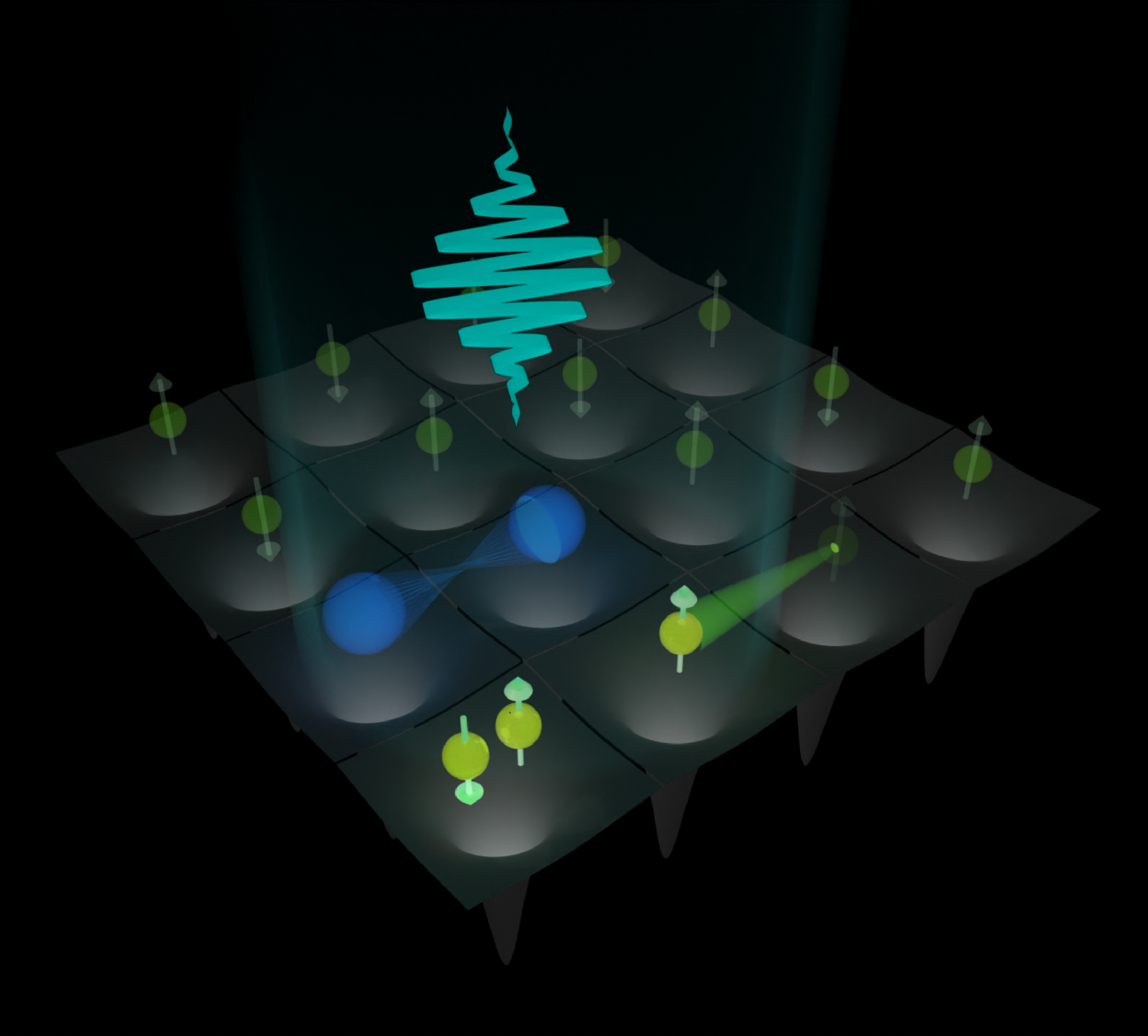
Ultrashort pulses of light now allow us to not just probe quantum materials, but to drive them into emergent phases away from equilibrium, realizing light-induced ordering, electronic condensates, and light-matter hybrid states. In this context, we develop new methods to (1) generate intense, tailored electromagnetic fields, and (2) probe driven states at femtosecond timescales, towards the goal of light-driven “Hamiltonian engineering”.
We generate tunable THz pulses to drive collective excitations with mode-specificity. Further, we create temporally structured optical fields to realize new nonequilibrium phenomena, including parametric amplification and metastability. We are exploring nanophotonics as a means to achieve extreme confinement of light, with the goal of amplifying light-matter coupling and harnessing vacuum fluctuations to control quantum materials.
We combine this with new probes, including time-resolved resonant x-ray scattering, multidimensional THz spectroscopy, and photon correlations, allowing us to witness driven quantum materials with element-specificity and energy and momentum resolution.
Relevant publications
“Symmetry-protected electronic metastability in an optically driven cuprate ladder,” H. Padma, et al. Nature Materials 24, 1584 (2025)
“Light-induced charge order mode in a metastable cuprate ladder,” H. Padma, et al. Physical Review Letters 136, 196501 (2026)
Experimental Methods
Strong-field THz spectroscopy
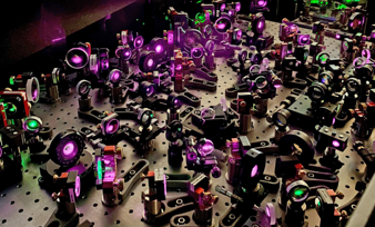
We generate phase-stable, intense, narrowband THz pulses tunable across three orders of magnitude in frequency, using home-built chirped pulse difference frequency generation, enabling resonant driving of a wide range of collective modes in solids. This is combined this with echelon-based “single-shot” THz spectroscopy, allowing for ultra-sensitive detection of THz transients. One of our goals is to establish 2D THz spectroscopy in high magnetic fields as a method to probe quantum geometry in correlated materials.
Femtosecond x-ray scattering and spectroscopy
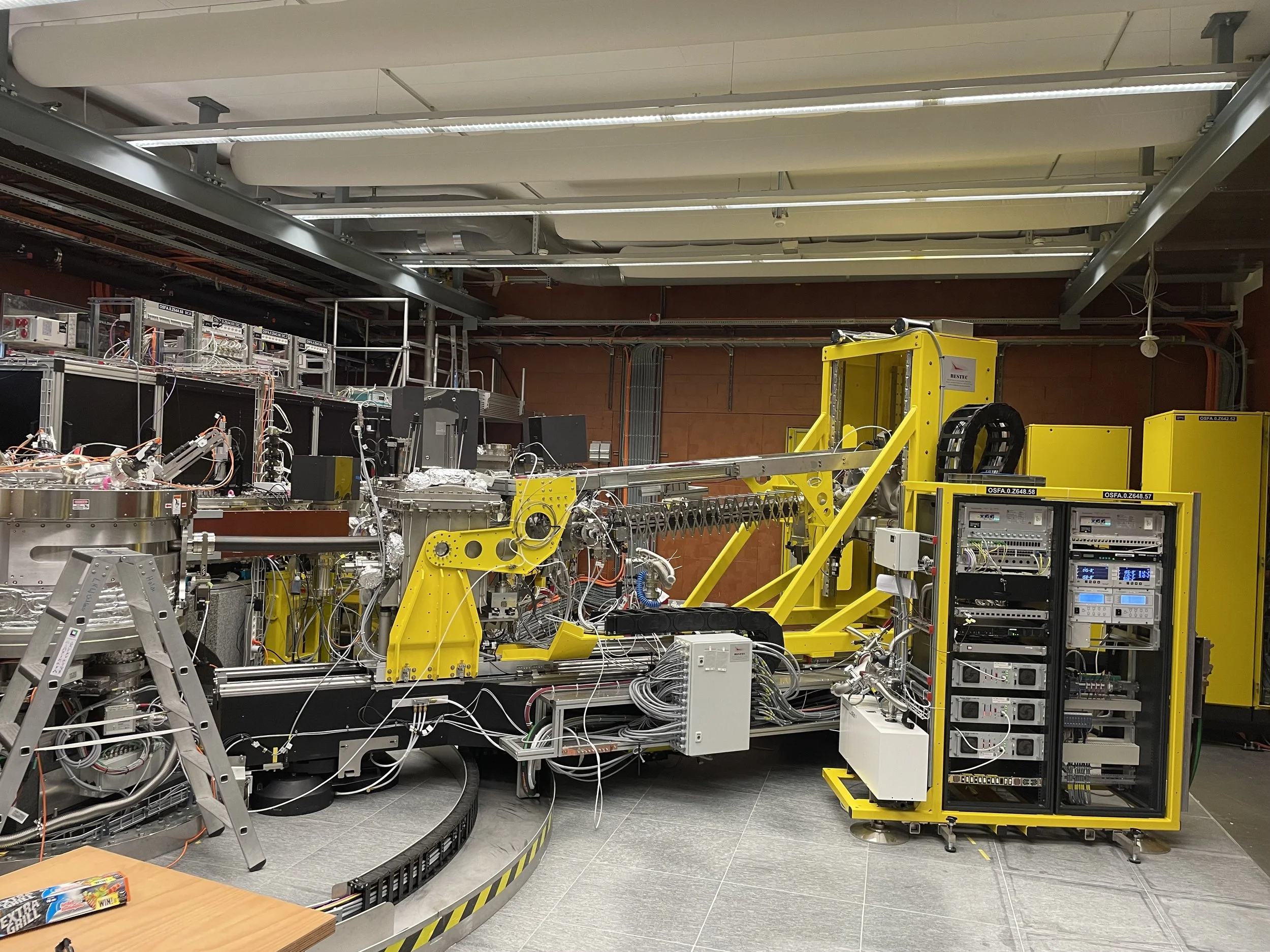
We employ time-resolved x-ray techniques at x-ray synchrotrons (Brookhaven, Argonne) and free electron lasers around the world (SwissFEL, LCLS, PAL-XFEL). In particular, we use time-resolved x-ray absorption spectroscopy (trXAS) to probe valence orbitals and electronic occupation with element-specificity, and time-resolved resonant inelastic x-ray scattering (trRIXS) to probe driven collective modes with time, energy, and momentum resolution. We envision interfacing these tools with new methods of light control, including temporal structuring of pulses and nanophotonic engineering of the electromagnetic background.
We will be moving into a state-of-the-art optical spectroscopy laboratory in the historic Rockefeller Building in Fall 2026. Renovations are ongoing, stay tuned for updates!